
Have you ever wondered why your ads stop working when you spend more?
Your campaign is doing well at $5,000 a month. So you get excited and push it to $10,000, expecting your sales to roughly double.
But that does not happen. The extra spend brings in far fewer new sales than you hoped, your numbers get worse, and your cost to get a customer starts climbing fast.
Now, there are a few reasons results tank when you scale. Your creative might be fatiguing. Your offer might be weak. Your tracking might be lying to you. Any of those can be the culprit, and it is worth ruling them out.
But there is one reason that catches almost everybody eventually, no matter how good their ads are. It is baked into how audiences work, and you cannot out-create your way around it.
Let me show you what it is, and what to do when you hit it.
Why Your Ads Stop Working When You Spend More Money
The reason I mean is this: scaling ad spend is not a straight line. Most people assume it is. Double the budget, double the sales. It almost never works that way.
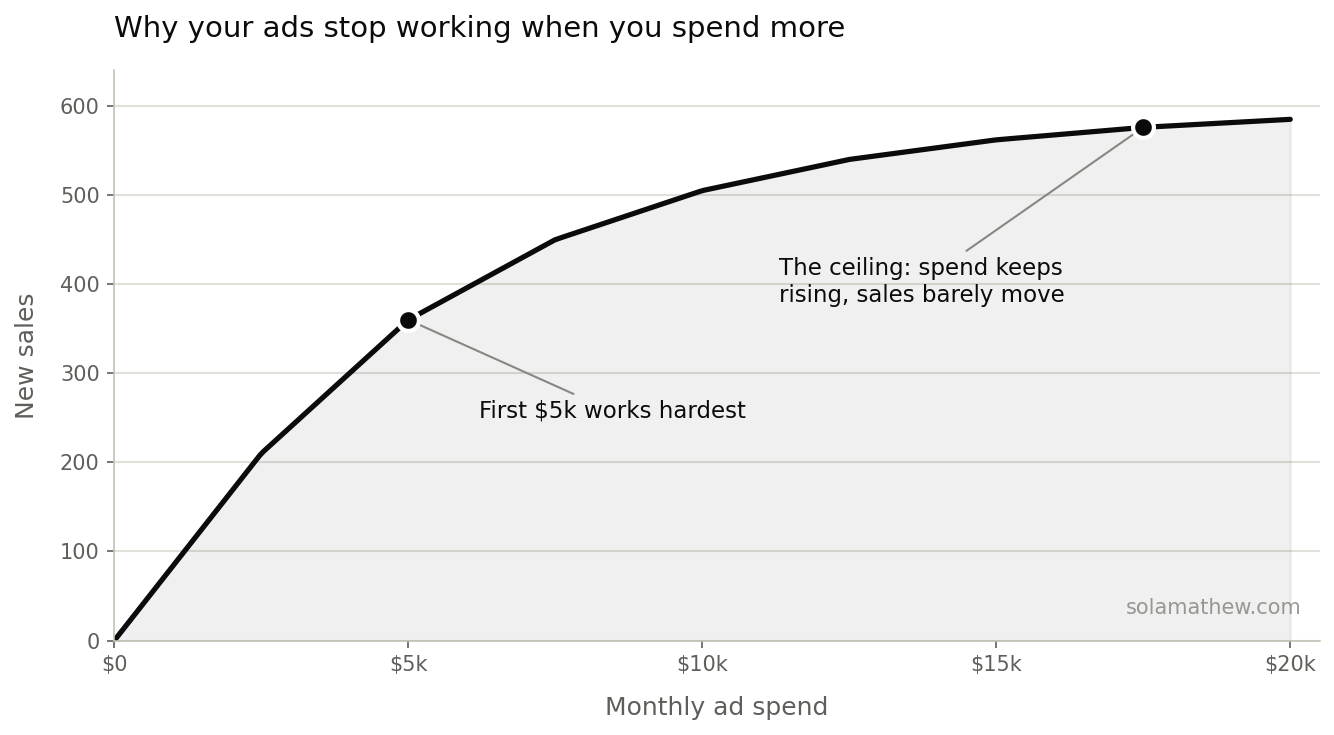
There is a concept behind this that I picked up in my ongoing Digital Marketing MSc, and it confirmed something I already saw happening in real accounts every day. It is called polynomial regression.
That sounds painfully technical, so let me strip it right down.
It simply means the relationship between your spend and your sales is a curve, not a line. It bends.
At the start, spending more brings in a flood of fresh sales. The line shoots up. But at some point it starts to flatten. You keep spending more, and the extra sales get smaller and smaller.
Eventually the line goes almost flat. You are pouring in more money and barely moving the needle.
That flattening is the ceiling. And the reason it happens is simpler than the maths behind it.
You Run Out of Fresh People to Show Your Ads To
Every audience has a limit.
At $5,000 a month, you are reaching the people most likely to buy. Easy sales. But when you jump to $10,000, you start showing your ads to the same people over and over, and to people who are less and less interested.
That is audience saturation. You have run out of fresh eyes.
Your cost to acquire a customer starts to skyrocket because you are paying to reach people who were never that likely to buy in the first place. The second $5,000 simply cannot work as hard as the first one did.
Understanding where that curve flattens is the whole game. It is what separates profitable scaling from just burning cash. You have to know exactly where your efficiency drops off, so you can protect your profit margins instead of feeding money into ads that have stopped delivering.
Also Read:
– ROAS Is A Vanity Metric: What DTC Brands Should Track Instead
– How to Scale Ad Spend Profitably Without Raising Your Budget
So What Do You Do When You Hit the Ceiling?
Here is the good news. Hitting the curve is not the end of your growth. It just means the next stage of growth comes from somewhere else.
Now, you have a few levers here. You can open up new audiences and new platforms. You can refresh your creative to win back efficiency. You can improve your landing page so more of the traffic you already pay for actually converts.
All of those help. But the two moves I want to focus on are the ones most advertisers ignore completely, because they are not as exciting as launching a new campaign. They work by pulling more value out of the traffic you already have, instead of buying more of it.
Increase How Much Each Customer Spends
The first move is to raise your average order value.
If every buyer spends more per purchase, you make more money from the exact same number of sales. And that extra revenue means you can comfortably afford the rising cost of getting a customer as you scale.
You do this with simple additions. Strategic product bundles. A post-purchase upsell. An order bump at checkout. None of these cost you a penny in extra ad spend, and they lift the revenue on every single transaction.
A higher average order value quietly raises your entire ceiling.
Sell to the Customers You Already Paid For
The second move is to stop relying on paid ads for every single sale.
This is the Nurture phase of my PLANT Framework. Once someone has bought from you, you have already paid to acquire them. Going back to Meta or Google to reach them a second time is just paying twice for the same person.
Instead, you drive repeat purchases through email marketing and backend offers. You own that channel. It costs you almost nothing to send, and it goes to people who already trust you enough to buy once.
The most profitable customer you will ever have is the one you do not have to pay a platform to reach again.
The Real Lesson
When your ads stop working as you spend more, the answer is rarely to keep forcing more budget through the top.
There is no single fix that works every time. But if you recognise the curve, respect where it flattens, and put your energy into raising your order value and nurturing the customers you already have, you give yourself room to keep growing long after the paid traffic stops getting cheaper.
That is how the best advertisers keep revenue climbing when everyone else is just spending more and wondering why it stopped working.
So I will hand it over to you. When you hit the curve, what do you do to keep your revenue growing? Tell me in the comments.



0 Comments